ESG under scrutiny as investors, banks and tenants raise the stakes

Green Forum
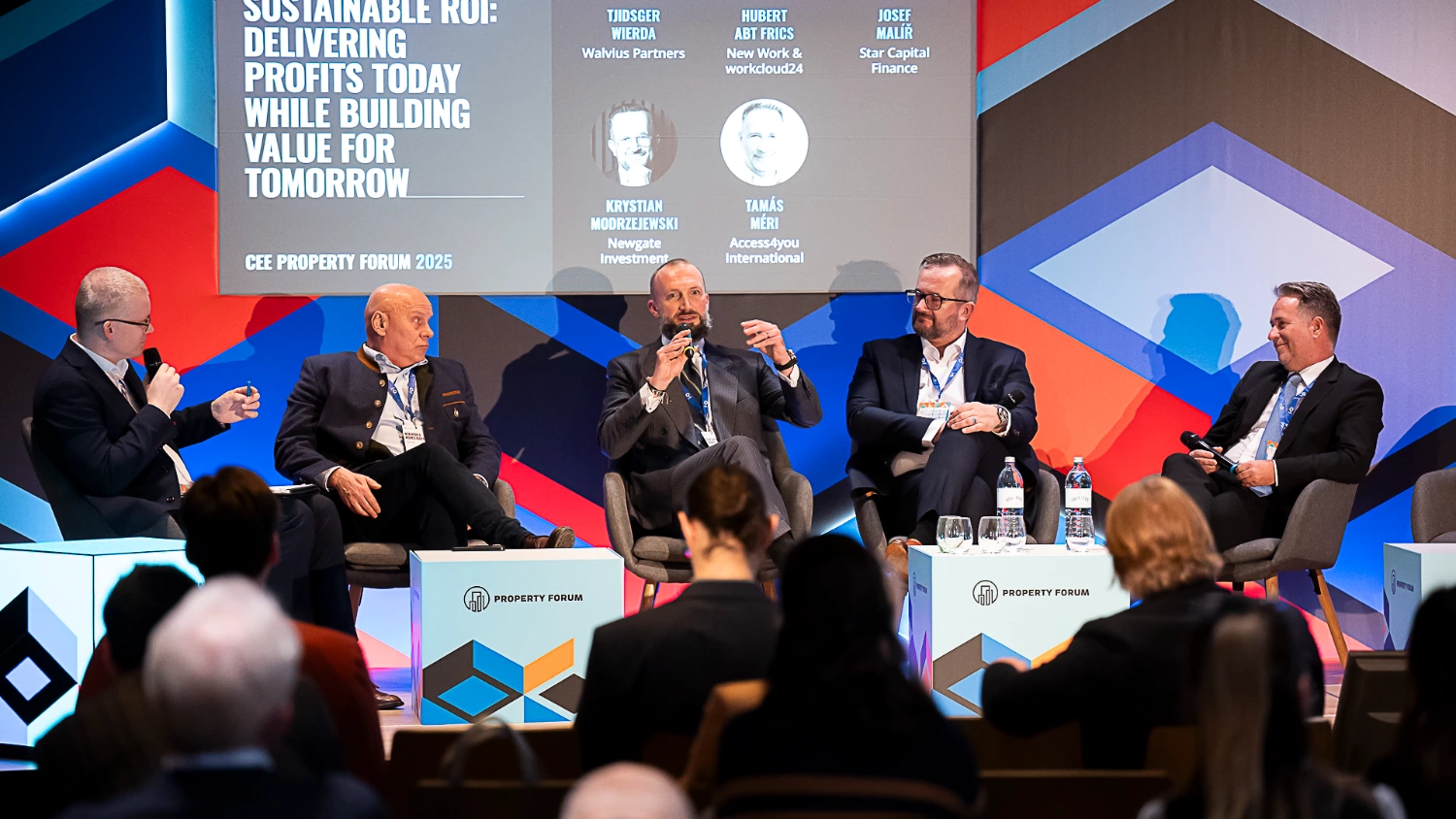
As ESG expectations move from aspiration to obligation, real estate leaders are being forced to confront how sustainability directly affects asset value, financing and long-term resilience. Chaired by ESG Partner Tjidsger Wierda of Walvius Partners, the sustainability session at CEE Property Forum 2025 brought together a range of expertise and pragmatic perspectives on the evolving role of ESG (Environmental, Social, Governance) in commercial real estate.

Hubert Abt, FRICS, CEO of New Work & workcloud24, contextualised ESG not as a regulatory checkbox but as a cornerstone of asset resilience and risk management. Reflecting on shifting industry paradigms, Abt observed, “Our sector has reached a crossroads—discussion is no longer enough, and the focus must be on practical action. As I like to say, it's not just about ESG compliance, but about ensuring the resilience of cash flow; a building that loses its insurance or financing due to non-compliance isn't sustainable in any sense.” Abt further noted that, “The regulatory environment is evolving rapidly. Either you adapt today or risk becoming obsolete tomorrow, because when financing or insurance disappears, so does the viability of the asset.”

The pragmatic thread was continued by Krystian Modrzejewski, Chief Investment Officer at Newgate Investment. Drawing on operational realities in the Central European market, Modrzejewski stated, “The market once regarded ESG as a cost burden, but it's increasingly clear that innovation and efficiency are keys to survival. By integrating solutions like rainwater harvesting, energy production, and automation, we not only control operating costs but also future-proof our portfolios against regulatory and tenant-driven demands.” He emphasised the shift in sentiment among stakeholders: “The banks and our largest tenants are already demanding proof of sustainability. We can be proactive or we can be forced to catch up at a much higher cost in the future.”

Bringing an investor's perspective, Josef Malíř, Executive Director at Star Capital Finance, clarified the balance between responsible stewardship and profitability. “In our business, sustainability is an opportunity as well as a challenge,” Malíř explained. “Our strategy involves identifying stakeholders and creating value for investors while maintaining a robust ESG approach—often before the acquisition even takes place. There's much talk about risks, but the real risk lies in neglecting sustainability and losing relevance to both investors and tenants.” Malíř added, “Even seemingly simple steps, like upgrading lighting to energy-efficient LEDs, demonstrate that sustainability and profitability are not mutually exclusive.”

Tamás Méri, Co-Founder and Chief Business Development Officer at Access4you International, broadened the discussion to social inclusion and accessibility, urging the audience to see universal design as both a commercial and social imperative. “True long-term value lies in creating environments accessible to all,” stated Méri. “By providing transparent information and removing barriers for disabled users, we capture a broader market, enhance tenant retention, and embed trust within our communities. Accessibility isn't just a regulatory concern—it's about making choices that build equity and resilience for every stakeholder.” He concluded, “The cost of changing a mindset is far less than the future cost of exclusion. Trust, transparency, and inclusivity are seeds for sustainable growth.”
RECOMMENDED
Smarter operations for older buildings: Unlocking fast energy savings with AI control
Real estate

Smarter operations for older buildings: Unlocking fast energy savings with AI control

Older buildings usually consume more energy in operation than new construction. That is not only a cost issue. It also affects how an asset performs against market standards like BREEAM, EU Taxonomy, and CRREM, as well as regulations such as the Energy Performance of Buildings Directive and the rules for Building Automation and Control Systems (BACS). Many owners assume the only way to close the gap is a major refurbishment. Better insulation and new equipment certainly help, but they are expensive and disruptive. Investments in deep fabric and equipment upgrades can reach one to five percent of the asset value.

New energy certificates directive shifts from recommendations to sanctions
Real estate

New energy certificates directive shifts from recommendations to sanctions

Only 14% of office buildings across the Prague market have achieved an Energy Performance Certificate in class A or B, with older properties having a higher probability of being classified in lower energy performance classes. An internal Savills survey, covering dozens of properties, has revealed that a significant proportion of Prague's office stock is facing the need for modernisation. 

Prague to host GBCI Circle Europe 2025
Real estate

Prague to host GBCI Circle Europe 2025

The GBCI Europe Circle conference was established to provide the LEED community in Europe with a space for professional and social exchange. The next edition is scheduled to take place in Prague from May 14-16 and Property Forum is proud to be joining the event as Media Partner. More about the event's significance and program has been shared by Kay Killman, Managing Director of GBCI Europe, Vessela Valtcheva-McGee, Director Market Development EE and Simona Kalvoda, Executive Director of the Czech Green Building Council (CZGBC).

E.ON Romania: We are on right track towards a sustainable future
Energy

E.ON Romania: We are on right track towards a sustainable future

A key component of the sustainability strategy that E.ON pursues is to be climate neutral by 2040, says CEO of E.ON Romania, Volker Raffel. He talked to Green Forum about the group's strategy regarding sustainability, its ESG policies, and E.ON Romania's sustainability goals for the next period.

RECOMMENDED FROM THE HOME PAGE
Energy

Waldevar Energy builds utility-scale PV parks in Romania

Waldevar Energy has begun construction on two utility-scale photovoltaic parks for Doral Energy in Tudor Vladimirescu (Brăila County) and Ștefan Vodă (Călărași County), Romania. The projects will deliver 14 MWp of installed capacity using around 25,000 photovoltaic panels.

Industry

Lidl Romania exceeds 2030 sustainability targets early

Lidl Romania has published its eighth sustainability report for the 2024 financial year, announcing accelerated progress in reducing environmental impact. The retailer has achieved its international 2030 target for transitioning to natural refrigerants, with these now used in 100% of logistics centres and 81.7% of stores, compared to the original goal of 100% of logistics centres and 40% of stores. The company has also increased its green energy usage to 80% of total consumption.

Energy

Dentons advises OX2 on 235 MW Romanian wind acquisition

Global law firm Dentons has advised OX2 on acquiring three wind power projects totaling 235 MW in Romania from Future Power. The projects, located in Vaslui and Vrancea counties, are expected to be commissioned between 2028 and 2030, subject to permitting.

Energy

Turkish investors pour millions into Romanian green energy

Romania is emerging as a key destination for Turkish renewable energy investments, attracting growing interest from industrial and financial groups. Real grid connection opportunities for projects, infrastructure modernisation potential, and investment framework stability make Romania strategic for Turkish capital as Europe accelerates its transition to sustainable sources and energy independence.

READ MORE
Green Forum  |  17 December, 2025 at 8:49 AM
Green Forum  |  11 December, 2025 at 11:36 AM